
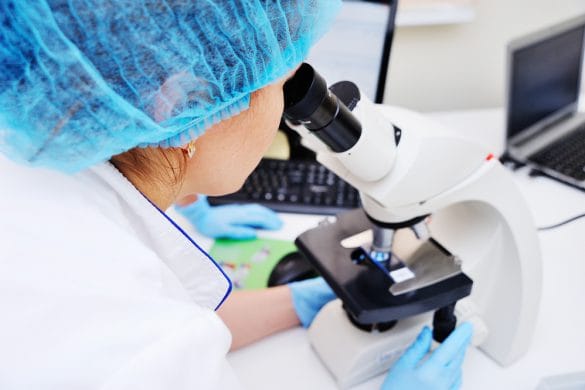
A biopsy is one of the key tests used to diagnose cancer. It involves removing a tissue sample for examination to confirm the presence of cancer.
The results help oncologists determine the cancer type and plan the best treatment approach.
What is a Biopsy?
A biopsy is a minimally invasive procedure where a sample of cells or tissue is removed from the body and examined under a microscope for abnormal cells.
It is recommended if a physical exam or other tests reveal something suspicious, or if symptoms suggest a serious condition.
A biopsy is required to confirm most types of cancers.
Some biopsies are performed in a clinic; others require an operating room and anesthesia.
When is a Biopsy Required?
A biopsy is usually recommended when there’s an unusual finding such as:
- Change in shape or color of a mole
- A persistent lump or mass
- Abnormal finding on a mammogram
- Abnormal blood cell counts
- Suspected cancer spread to bone marrow
- An oral lesion lasting over two weeks without healing
- An inflammatory lesion not responding to treatment within 10–14 days
- Abnormal growth or polyps found during colonoscopy
How Does a Biopsy Detect Cancer?
Under the microscope, cancer cells differ from normal cells in several ways:
- Abnormal size (larger or smaller)
- Distorted shape
- Dark, enlarged nucleus
- Disorganized tissue structure
- Cells not belonging to that tissue type
Biopsies help identify the cancer type (based on resemblance to normal cells) and grade (how different they are from normal tissue — high grade means more aggressive).
Types of Biopsy Procedures
Various biopsy methods exist, often using a sharp tool. Local anesthesia is used for sensitive areas.
Fine Needle Aspiration Biopsy
Uses a thin needle attached to a syringe to collect a small cellular sample. Used for palpable masses like enlarged lymph nodes or breast lumps.
Core Needle Biopsy
Uses a larger needle to remove a tissue sample. Provides more tissue for detailed analysis. Preferred for breast lumps and larger swellings.
Image-Guided Biopsy
Used when a tumor isn’t palpable (e.g., in lung, liver, prostate). Guided by ultrasound, CT, MRI, or X-ray to precisely target the area.
Can use fine needle, core needle, or vacuum-assisted devices.
Vacuum-Assisted Biopsy
Uses suction to collect large or multiple tissue samples from the same site. Can be image-guided.
Excisional Biopsy
Removes the entire suspicious area. Used for abnormal moles or small, easily removable tumors.
Shave Biopsy
Removes tissue from the skin surface using a sharp tool.
Punch Biopsy
Uses a circular tool to extract a sample from under the skin surface.
Endoscopic Biopsy
Uses a thin, flexible tube (endoscope) with a camera and light to view internal organs (e.g., GI tract, bladder). Tissue samples are taken with forceps.
Laparoscopic Biopsy
Uses a laparoscope inserted through a small abdominal incision to view and sample abnormal areas.
Bone Marrow Biopsy
Used to check for blood abnormalities or cancer spread. A long needle draws marrow from the hip bone under local anesthesia.
Liquid Biopsy
A non-invasive alternative. Analyzes blood or fluid (e.g., pleural fluid) for cancer DNA.
Allows repeated testing to monitor tumor progress and treatment response with fewer risks.
Still under research and not widely used for initial diagnosis.